Betrayal of Trust: Credit Bureau Profiteering

Sunday, June 27, 2009

Information about our credit behavior is provided to the credit bureaus by the various lenders from which we have borrowed money to buy merchandise and services, cars, houses, education, you name it. In turn, these credit bureaus – principally Equifax, Transunion and Experian –provide our credit histories to prospective lenders which we have approached to obtain additional or replacement credit – a new credit card, a car loan, mortgage refinancing, student loan, etc. Understandably, these credit bureaus provide this information subject to federal and state laws designed to protect us against its dissemination without our knowledge or authority.

This flow of information is carefully managed, and properly so. The more widely and more casually our credit histories are published, the greater the likelihood of identity theft. More to the point, the details of our financial lives should be nobody’s business unless we, personally, decide they should be. Credit reports are highly personal information that you and I need to protect. Not that big a deal, you’re thinking? Okay, who reading this would want to hand out copies of his or her credit report to your neighbors, family, friends, coworkers or random strangers you pass on the street? I didn’t think so.

Well, it turns out that the same credit bureaus which make a point of how trustworthy they are in virtuous compliance with every federal and state regulation – which they are – have been making more than a little money on the side in complete contradiction to the public trust.

Ever receive one of those advertisements in the mail from a lender offering you refinancing or debt consolidation? Of course you have. Some of them describe the services they offer by way of examples, unrelated to your specific situation, to describe the advantages of their programs, but others… Others actually show the precise amounts of your mortgage, credit card and other obligations to calculate how much they can save you. Wait a minute. You didn’t apply to these companies for credit. You didn’t authorize or know about the release of your financial data to these companies whose services you never solicited. And they have no right to your data because you don’t already owe them money. So how did they find out the amounts of your mortgage, credit card and other debt?

The simple answer is that the credit bureaus sold it to them, in bulk. They’re called “promotional inquiries” – detailed personal credit information, including basically everything on your credit report, which the credit bureaus sell to companies who want to make you unsolicited offers – and they don’t show up on your credit report. That they don’t show up on your credit report is good in that they have no effect on your credit score. The bad news is, because they don’t show up, you have no way of knowing that your credit history has been sold and who has it. It’s a secret, and not the good kind.

What’s the point? The point is that our federal government needs to do something, needs to do more to protect the privacy of our financial data to keep it out of the hands of marketing firms who, without our authority or knowledge, have no right to it.

-wf


Site Meter

Universal Healthcare: Legislating in the Dark

Thursday, June 25, 2009

Question of the Day… Shouldn’t the President ask the medical profession to define, in very precise terms that read like an insurance policy, the minimum level of coverage which it recommends to ensure the health of all Americans first, before attempting to push a bill through Congress?

The objective, I thought, was to provide minimum healthcare for all Americans. Okay, what exactly does that mean? What’s the minimum policy we want all Americans to have?

Once we know that, the next question for both the medical profession and insurance companies is how much will it cost to provide that coverage?

Not that President Obama hasn’t reached outside The Whitehouse for advice, but he hasn’t been in office long enough for medical and insurance professionals in the private sector to come to a consensus and provide this essential information. It’s what Congress needs to understand the costs and effectiveness of different means of providing this coverage to those who can’t afford it without assistance.

First things first, Mr. President. Take your time, and get it right.

-wf


Site Meter

The Last Laugh Hypothesis: An Alternative Foreign Policy for North Korea

Thursday, June 25, 2009

North Korea, however reprehensible its government, has the same right to have weapons, nuclear or other, as we do. If, let’s say, Denmark decided it wanted nuclear weapons, would we be threatening economic sanctions and forcibly boarding their ships? Of course not. We don’t like North Korea, but that we don’t trust its government is no excuse for telling it what to do. Lots of countries don’t like or trust our government. Do we tolerate them telling us what to do? Do we really even care what they think? The fact is, we pick on North Korea because we are big, strong, wealthy and we can get away with it.

The fact is, we have no moral ground to tell North Korea to stand down. Our nuclear arsenal is huge. We have the technology for delivering those weapons over vast distances and with incredible precision. And we are the only country to have ever used one, twice. Where exactly do we get off telling another country that it can’t have the weapons we already have in abundance, and refuse to dismantle?

Unfortunately, in the process of throwing our weight around with characteristically impatient foreign policy, we have created a world in which tough talk and threatening to build nuclear weapons is a way to get our attention. The more they pound their chests, the more we pound ours which may work for gorillas and adolescents on a school playground. As foreign policy, however, it’s a counterproductive waste of time, money and, quite possibly, lives.

Let’s try something very different. Instead of punishing the North Korean people for their government not behaving the way we would like, why do we just step back and let its government build whatever weapons and suppress its people as it sees fit. Let’s put aside the guiding principal that no country whose government that isn’t democratically elected has quite the same sovereign rights as one whose government is. Instead, let’s open our economy to this rogue nation, avoiding only certain high technology sectors for now.

Mind you, I’m not suggesting that we offer economic assistance, or cooperation which is really what I have in mind, as a reward for not developing nuclear weapons. That would just be encouraging bad behavior. No. What I’m suggesting is that we stop talking about nuclear weapons and make an unconditional offer of open, bilateral economic development with the United States and other western nations. “What can our economy do to work with your economy? …No strings attached.”

The objective is to link their economy to ours and do everything we can, through our private sector and without US government assistance, to improve the quality of life for the North Korean people. It will take time, years, but the magic of economic development will eventually have its effect, gradually at first, but then increasingly so. Over time, government leaders will come and go, overseeing an increasingly open North Korean society that serves a growing class of entrepreneurs and business and other professionals who demand the freedom to enjoy the benefits of their labor and creativity.

And one day, the North Korean government we once distrusted, rightly so, will have made the transition to democracy which Capitalism demands, and will no longer care about the nuclear weapons we once feared they would build. Why? Because, to put it simply, people with stuff will do their best to take care of it and acquire more stuff – which doesn’t give them the time or motivation for warmongering.

One thing’s for sure. Whatever we’re doing now isn’t working. Why not give economic development a chance? The current regime in North Korea will think it has won, has made its point, oblivious to the irrepressibly infectious capitalism we spread to every economy we touch. Fine. It is a victory without substance, of rhetoric we can easily tolerate, without the sticks and stones which are our real concern. Years from now, when the current government is history and North Korea is the new South Korea, we will have had the last laugh.

-wf


Site Meter

President Obama: Government High

Wednesday, June 24, 2009

“The question for the media to ask at President Obama’s next news conference is not whether or not he’s smoking, but what?”

What is President Obama’s problem with free markets? Or with Capitalism, for that matter?

If a President doesn’t like the way a market is behaving, he can look for the influence of monopoly, “externalities” or other factors which are interfering with the outcome you might expect from a truly competitive offering of goods and services. Without question, there are markets which don’t work well – which is why we have and can create laws and simple programs to eliminate or correct for the influence of these non-competitive forces.

What we don’t want our government to do is create companies to compete with the private sector. To do so constitutes nothing less than a perversion of the role of government in a Capitalist economy. The government’s role when it comes to our economy is best described as “benevolent influence.” To go into competition with private sector firms, to set a benchmark for pricing and the delivery of products or services, reflects a ludicrous misunderstanding of our history and the design of the Capitalist engine which has made all we have accomplished possible.

Whether it’s an issue as important as healthcare, or as trivial as “widgets,” makes no difference. The question for the media to ask at President Obama’s next news conference is not whether or not he’s smoking, but what? Think of the precedent which offering a government health insurance program sets. Every time the President deems a market’s behavior inappropriate, does our government go into competition with the private sector to offer consumers an alternative he likes better?

This is one of those times when I don’t understand why anybody is missing this point. Maybe, like not seeing the forest from the trees, it’s so fundamental that no one in Washington gets it. It is the very nature of Democratic Capitalism that it precludes government as a participant, as a manufacturer of goods and services in the economy. The reasons are both too numerous to list, and too obvious to waste time describing. That’s not Capitalism.

We have elected a President who believes he and his government know more about running the economy than the economy itself. This man’s high on government like no one I’ve ever seen in my lifetime.

Well, heaven forbid I should be critical without offering an alternative solution. (1) Reach out to the medical profession for its help in defining the minimum coverage necessary to protect the health of all Americans. (2) Bring the insurance industry to the table to work with the medical profession to define the insurance program that would offer that standard coverage, every detail right down to the use of universal forms. (3) Subsidize the costs of obtaining that insurance for Americans who cannot afford it on their own. For people who can afford their own, probably superior coverage, they can continue to buy, directly or through their employers, whatever programs they choose.

President Obama may like to remind us, as he did at his Rose Garden press conference, that only he is President of the United States. Well, somebody, I guess that’s me, needs to remind the President that, when it comes to the economy, he has no idea who, or what, he’s dealing with. No one knowingly elected him to effect the de-Capitalism of America, and neither the people nor the economy will tolerate the government fiscal and national economic mess he’s making.

-wf


Site Meter

“You suck.” Diet advice from the WordFeeder.

Sunday, June 14, 2009

Forget politics and the economy and, my favorite, the flash fiction I love to write. Let’s lose some weight. I’ve lost 14.5 pounds, so far, and I wasn’t all that huge when I started. In fact, most people never thought of me being overweight, not really. Here’s how I did it. Maybe you’ll have some suggestions of your own, and share them with me. Remember, I’m no doctor or dietician which will be obvious in a moment. I don’t even read diet books, and I can’t stand the concept of tofu. I’m just a guy who likes to write and who has decided, at long last, to revisit “Les Lite,” the original me. (As some of you who occasionally read my stuff already know, my name is “Les.”)

I’ve been overweight for… well, forever. Recently, I got on my bathroom scale which I do every morning as soon as I get up, figuring that’ll be the lightest I am that day. It’s a digital scale with real big numbers that I can read before I put my contacts in, without having to scrunch myself down into a ball to see them. No offense to the manufacturer or the 20 whole dollars I spent for it on sale at Bed, Bath and Beyond, but… (Am I the only one who always says the name of that place like I was Buzz Lightyear with a fake echo effect? “To infinity, Bed, Bath and Beyond!” Just curious.) …this scale is no piece of precision scientific equipment. Hardly. In fact, my weight varies as much as two pounds depending upon precisely where it is on the floor and the extent of the warm up I allow it. On the scale, off and on again three or four times, and then I take the lowest number.

One day a couple of months ago, I got on my bathroom scale and realized I was 32.5 pounds overweight. (My scale only shows half pound increments.) That’s 32.5 pounds overweight by my own personal formula which is the sum of what I weighed when I graduated college, plus 10 pounds because I’m in so much better shape now than I was then. That’s right. I heard somewhere that muscle is not only more efficient than fat at burning calories, it’s also heavier. I don’t know if that’s true, but it’s an idea I like.

On my way back from my scale which is at the end of our bowling alley bathroom, just in front of the dirty clothes hamper and dormer window behind it, I stopped to look at myself in the mirror, still wearing the t-shirt and running shorts I use for “jammies.” Without a moment’s hesitation, the little voice in my head typed out a two word sentence in large white letters, courier font, suspended in the air in front of my eyes. (My little voice always types what it has to say.) One letter at a time, to the sound of the old manual typewriter on which I first learned to type, its message was clear. “You suck.” As usual, it took an extra fraction of a second to add the period – I’ve long suspected because I used to have trouble finding and pressing the period key when I was a kid.

This is the first piece of diet advice I have to offer which I understand may be completely contradictory to popular psychology: “Until you reach your target weight, do whatever you can to reinforce a negative body image.” It’s not about feeling bad about yourself per se, which in and of itself isn’t usually a good thing. It’s about motivation. I’m going to lose weight until I don’t suck anymore. I’ve actually had a t-shirt made that says, “You suck,” in large white courier type, and in reverse so it reads right when I look in the mirror. And I’m wearing to bed every night for as long as it takes.

Want one? It’s really effective. I’ll actually send, I don’t know, the first 5 of you who write me real comments in the next couple of days about your diet experience, a “You suck.” reverse type t-shirt, my treat – if you can find a way for me to mail it to you without making you uncomfortable about giving me a name and address and without publishing it on the WordFeeder. I have a PO Box for the Wordfeeder. Maybe you do, too?

Next piece of advice, stop eating things which are all about carbohydrates. I think you’ll get all the carbohydrates you need in the other foods you eat and drink. No bread – although I allow myself half an English muffin with the fake eggs (yellow colored egg whites) I have for breakfast. No potatoes, no pasta, no pastries, and no desserts. Having problems with that last one? Just remember our mantra: “You suck.” This works. So does frozen yogurt with lots of Nesquick chocolate sauce which is so much better than Hershey’s. By “lots” I mean so that the yogurt is like an iceberg, mostly submerged, making a little white island in a dark brown ocean, missing only the single palm tree. It’s my chocolate fix for the day. And no sodas. Diet sodas may not have any calories, but they taste awful. Com’on. Admit it. You know they’re no substitute for the real thing. Nothing without the sugar or fat of the original ever is.

Eat smaller portions. You’ll get used to it. Amazingly, the smaller plate trick helps.

Stop eating out so much. The portions are too big and choices too caloric, too fatty. I’m sure it’s not a medical fat, but I’ve convinced myself that “The more fat you eat, the more fat you keep.” Sorry, I can’t help myself. It’s the writer in me. I’m creating slogans to write myself into losing weight – although I probably can’t take credit for the first one, “You suck,” since I’m plagiarizing everyone who’s ever told me that, usually preceded by my last name and a comma, when my weight had nothing to do with it.

Fruits and vegetables. Exercise. You know what to do. I’m learning to make my own salad dressings, which is probably how Paul Newman got started.

Here’s a tip… I’ve actually found that eating food which isn’t all that good – good for you, yes, but not necessarily good tasting – actually helps because I’ve stopped looking forward to eating so much. I love going to New York, which is easy living where I do, to the City of Big Signs where everybody eats out all the time, where eating dinner at 8 is okay, and going out later for pizza at midnight, mandatory. (What? You don’t eat 4 meals a day?) My daughter and her husband live there. That’s the main reason I like the place, but the other is that the food is great. Too great. Just make sure you walk between restaurants. That’ll help. However you do it, eating has got to stop being the highlight of your day.

Stop eating red meat. I don’t know why this helps. It’s probably just psychological, and the fact that a lot of red meat comes “two all beef patties, special sauce, lettuce, cheese, pickles, onions on a sesame seed bunnnnn.” Think of eating beef as dating someone with too much baggage. There are plenty of other sources of protein out there.

If you’re tired, take a nap. I’m in the habit of eating to stay up. Take a 20 minute nap. Exactly 20 minutes, or you’ll never get up. Don’t have time for a nap during the day? Go to bed earlier. No kidding. I work all the time, too. If I can do it, so can you. Sleeping is calorie and fat free.

Last piece of diet advice for today. Get used to not eating all the time. I’m a snacker, and I tend to eat a lot after dinner. The later it is, the more I eat – probably because I’m getting tired. Next time you get hungry, morning, afternoon, whenever, look at the clock. Say to yourself, “I’m not going to eat anything for another half hour, and that’s that.” Get back to work. The half hour goes by before you know it, and it turns out you weren’t all that hungry after all.

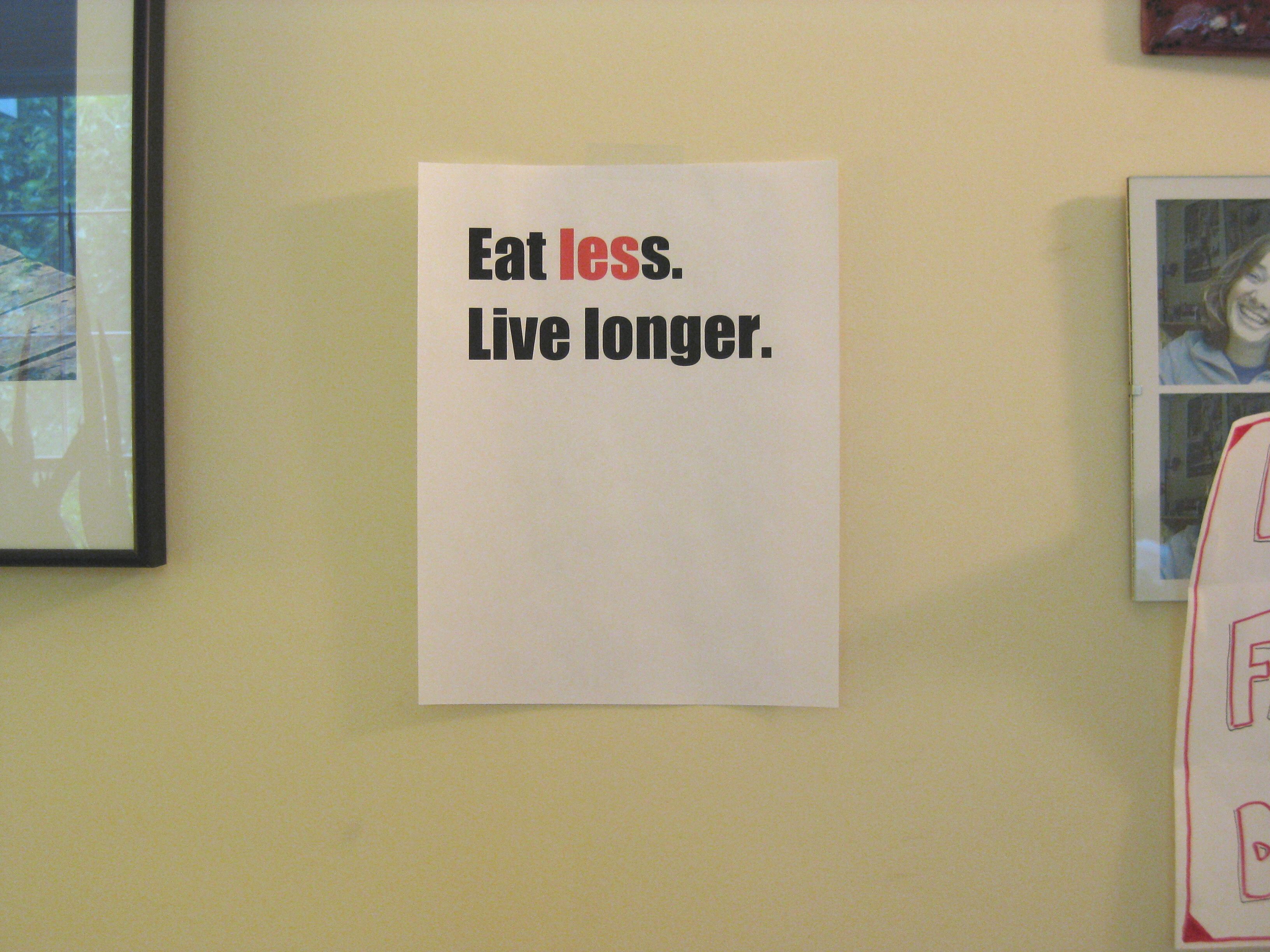
One more slogan, and we’re done – except for your comments and any bright ideas I have later. And in conclusion, I offer you the sign I have taped on the wall of my study, at just about the place I look whenever I stand up on my way to the kitchen. You’ll notice the not so subtle subliminal message to get my attention. Dieting is, after all, first and foremost, about motivation.

14.5 pounds down. 18 to go.

Eat less.  Live longer.

Diet advice from the WordFeeder.

-wf


Site Meter

Palin, Letterman and the Double Standard

Thursday, June 11, 2009

I’m not sure what’s more offensive, Mr. Letterman’s reprehensible sense of comedy and poor excuse for an apology, or the double standard that has plagued Governor Palin since her introduction to national politics. If Letterman’s comments had been about President Obama’s children, CBS corporate would have apologized for him, his contract would be in jeopardy, and I doubt his studio and TV audiences would have found his remarks as humorous. Mr. Letterman owes the Palin family a proper apology. In the meantime, I’m watching Conan O’Brien.

-wf


Site Meter

The Obankruptcy* of America

*Obama-induced bankruptcy.
Wednesday, May 27, 2009

Let’s begin by defining bankruptcy for the American government as a situation where we find ourselves unable to pay the interest we owe on our current national debt without borrowing more money to make those interest payments. I know, I know. “Been there, done that.” But imagine that we are so over-extended that domestic and other government buyers of our debt, particularly in light of financial problems they are themselves suffering, are reluctant to buy more. Now what? In laymen’s terminology, we can no longer borrow from one credit card to make the minimum payments we owe on another. People and governments have lost confidence in our government’s ability to manage itself and pay its bills. Our government is broke. Say all you want about economic recovery, this, that and the other, we’re broke. Reluctantly, Congress has no choice but to mandate a dramatic contraction of federal government spending sufficient to produce an immediate and very significant surplus.

It comes, this sudden and dramatic reduction in expenditures, at the expense of both new and long-term core programs. As for the many noteworthy objectives of our new President, it is an end of dreams, a devastating reality check that hurts, not only in terms of its impact upon our citizens and our authority in the community of nations, but because it was so entirely foreseeable and avoidable. The wealth and potential we have squandered are staggering. The embarrassment and loss of self-esteem, unforgiving.

Here’s how it happens…

1. An inexperienced President and Democratically controlled Congress that have no real concept of fiscal management take charge with a huge national debt already in place.

2. Harboring the mistaken notion that government needs to save the economy from itself, the Administration unnecessarily and recklessly wastes a trillion and more dollars we don’t have to spend, telling us we’ll get our money back from the firms it bails out as soon as they recover. To be kind, this will turn out to be wishful thinking.

3. Plans to reduce our commitment (and expenditures) in Iraq are delayed, even while our presence in Afghanistan expands. The costs of national defense provide no relief for our budget deficit. Quite to the contrary, the demands upon our military are increasing.

4. Slowly, the economy begins to recover on its own. The smart, responsible thing to do would be to generate a surplus and start paying down our national debt even if just by pennies a day, or at least minimize the deficit we’re incurring. Unfortunately, the Administration is unwilling to adjust its vision of government doing everything for everyone, all at once and immediately. It is adolescent play by our always well spoken President which we will live to regret. The deficit and the national debt continue to grow at what should be an alarming rate, demanding crisis level attention, were our President not high on his own special cocktail of over-confidence and naïveté.

5. And then something goes wrong, maybe something international that distracts our Administration and Congress and requires substantial additional financial commitments. (It’s the unexpected medical bill or transmission problem that savings or a credit card that wasn’t maxed out might have covered in an emergency.) That does it. Even our most liberal Congressional leaders realize that the incessant criticism from fiscal conservatives has been right – no pun intended – all along. (I’m not a Republican, by the way. Fiscal conservatism isn’t a political party concept. It’s common sense.)

6. So now what? Do we print more money to protect the President’s and the Democratic Party’s religious belief in the power of government? …Whoa. Wait a minute. This is like the Madoff scam, isn’t it? It’s the government version of a Ponzi Scheme, incurring new debt to pay the interest on existing debt.

No. That’s not what we do, at least I hope not. What happens, in this dream I’m having where America always figures things out just before it’s too late, is that our Congress, under pressure from its constituencies which have had it with runaway government spending, takes control of the budget. The President and his Party’s Congressional leaders cooperate, of course, so they can take credit, not for the mess they caused, but for the solution they eventually had to eat.

There, 6 easy steps to the bankruptcy of America, to the rude awakening, the slap in the national face after which, assuming we finally come to our senses, we say collectively, “Thanks. I needed that.”

Being a government is no excuse for fiscal irresponsibility.

Wouldn’t it be nice if, maybe just this once, we didn’t have to wait for a precipitant crisis to solve a problem that was so easy to anticipate?

-wf


Site Meter

The Problem With Telling North Korea (or Iran*) That It Can’t Have Nuclear Weapons

Tuesday, May 26, 2009

The term our media likes to use when it talks about North Korea is “rogue nation.” The point is that somehow, because they don’t behave according to our standards, they can’t be allowed to have nuclear weapons or other sharp objects.

Don’t misunderstand. I really, really don’t want them to have nuclear weapons technology. But, to be honest, I don’t want us to have nuclear weapons either.

Nuclear weapons are in a league of their own for the levels of societal and planetary destruction they can affect. They are extraordinary, literally and to say the least. I have thought long and hard over many years – since I was coached, as a child, by well-meaning teachers to hide under my desk in the event of a nuclear explosion – but have yet to conceive of a single circumstance under which I would advocate the use of these weapons by my own country. So generally devastating is their impact, I’m not sure they are appropriate to use even in self-defense. And I certainly believe in self-defense.

It’s not so much that I don’t want North Korea to have nuclear weapons, as much as it is that I don’t want anyone to have nuclear weapons, ourselves and our allies included. I see them as the explosive equivalent of a biological weapon. The very fact that they exist virtually guarantees their eventual use, by accident, by sociopaths regardless of their cause, not to mention by any one of the world’s most prominent and civilized nuclear powers. (What nation, regardless of its stature, that has nuclear weapons doesn’t have contingency plans to use them?) I fear their existence, but not in a mature and sobering way. They are for me, like their biological counterparts, the adult version of something that goes “bump” in the night.

My personal feelings aside, what do we do when a nut ball nation like North Korea, who we don’t trust not to use or irresponsibly disseminate nuclear weapons technology, wants a bomb of its own? The conceptually simple answer is that we – the entire world – need to pass a law, with rules and procedures for enforcement that makes it illegal, literally, for any nation – no exceptions – to have nuclear weapons. Wow. Breathtaking, isn’t it? In the meantime, we’re left with no option, if all attempts to negotiate with and bribe the offending government fail, short of destroying that country’s nuclear weapons capabilities. That’s an act of war. We may get away with it because we’re so big and strong, but it’s an act of war nonetheless.

There’s a problem with parents who smoke and then tell their children not to. With parents who take drugs or consume alcoholic beverages excessively and wonder why their children do the same. And there’s a problem with parents who, heaven forbid, use physical force to “control” their children, and wonder why those same children may exhibit violent tendencies themselves.

Yes, how to deal with the proliferation of nuclear weapons is a really difficult problem, and is not something we’re going to resolve any time soon. Pretty much never, at the current pace we’re going. (My guess is that it’s going to take a precipitant crisis, perhaps even an explosion, to get our collective attention in any meaningful way.) In the process, the one thing we need to do first is understand the negative example we and other nuclear nations are setting and revise our own behavior until we have the moral right to tell anyone else what to do.

*See “Why Iran has every right to develop nuclear weapons,” posted on the WordFeeder Wednesday, September 23, 2008.

-wf


Site Meter

Wrong Number

Short Fiction for Guests of the WordFeeder
Sunday, April 26, 2009
Printable version… Wrong Number

It was early on a beautiful Thursday morning in the city, on the kind of day that gave Spring its well-deserved reputation. The flowers in the large pots on either side of the stone platform outside his front door were blooming. The trees that lined the street in front of his and the other townhouses were beginning to fill in, some of them with delicate white blossoms.

And his suit… Yes, the suit that he wore every day – a medium gray this morning with an almost imperceptible blue fleck – fit his tall and trim 40 something body perfectly, the way expensive, custom tailored suits do. Nice suit, to be sure, but it was all about his choice of ties, the lead singer in his ensemble, with just enough color to make him feel good without attracting too much attention.

“Lock the door, please,” he said as it began to close behind him. There was no one there, but the lock, indeed the entire house, recognized his voice. “Of course, Mr. Street, I’ll take care of it immediately,” the soft professional voice of his “House Nanny” reassured him, followed by the “chunk” of his dead bolt lock.

Stepping briskly down the stairs, he turned right, walking quickly to the corner, saying, “Hi,” and “Good morning,” to passersby who invariably smiled back at him, a reflection of the friendliness, sincerity and success he radiated. Down to the corner, and then right again, without crossing the street, he barely stopped in front of the fifth stoop, snapping up the six steps to his company’s main entrance.

It was a block of what appeared to be 38 recently refurbished townhouses, each one slightly different, just a bit unique, but none so much so that it didn’t complement the ones on either side of it. And yet, almost no one lived in any of them. They were purchased over the course of a few years, carefully remodeled and integrated into a city block of offices for his company, and his company alone. No sign of anything corporate, they blended inconspicuously into the cityscape around them. A small park in the middle of the complex gave all the interior offices windows and balconies, many with hanging plants and flowering vines intermingled among the dark green leaves of ivy clinging to the brick. It was expensive, this invisible office building, but no more than a rounding error in the fortune that Innovative Concepts had amassed from its handful of patents on uncommonly useful items, from residential escalators, to GPS devices for keeping track of your children, to interactive voice activated household appliances and electronics.

“Good morning, Janet.” He said to the receptionist. She was real, and not one of the AI devices they were developing.

“Hey, Will. How are you today?” Regardless of status or authority, everyone who worked there was on a first name basis. That was the rule.

“Fine, thanks. “

“You’ve had three calls which I e-mailed you, and this,” she said handing him an envelope, “that arrived by messenger just a couple of minutes ago.”

Two flights up, and down the hallway through what would have been three more houses, he was at the senior executive suite of offices where he would spend most of his day. The two outer desks were for Diane, his assistant, and the new person, “Bobbie?” he tried to remember, who would be working for her. He had the bigger of the two street-front offices. The other was where Jack worked, doing the daily routine of running the company, while he, Will, concentrated on… on whatever he wanted to.

No one was in yet, but the phone on Diane’s desk was ringing so he picked it up. “Good morning. Can I help you?” And then he listed for a minute. “No, I’m sorry. You’ve misdialed. …No problem.” And he hung up the phone.

“Good morning.” It was Diane and Bobbie, the new person holding a bag of something from “Sweet Cakes,” the bakery down the street.”

“Good morning, ladies. Smells good.”

“We got an extra one for you?” Diane opened the bag, waving her hand over the open top to waff the smell of fresh cinnamon in Will’s direction. “How about it?”

“Tempting, but no thanks.” And then turning to Bobbie, his hand extended to greet hers. “Hi. You must be ‘Bobbie.’ Welcome aboard.”

“Hi,” she responded warmly, shaking his hand and returning his smile.

“Thanks for coming to work for us,” he told her, concerned that she might be a bit nervous on her first day, just as the phone on Diane’s desk rang again.

“Good morning. Innovative Concepts, can I help you? …Sure. No, you’ve got the right number. Let me transfer you to accounting. …Thanks.”

“Thanks. I’m looking forward to…,” but then Will cut her off as soon as Diane put down the phone.

“Diane, I’ve got stuff to think about. If anybody calls, would you tell them, I don’t know, whatever?”

“Sure thing,” she nodded back to him, and he turned, walked into the larger, much nicer of the two executive offices and closed the door behind him. Jack, on the other hand, still not in, would leave his door propped open with a cheap bookend he got from Staples, so he could shout to them without using the intercom.

“Well,” Bobbie turned to Diane, still standing in front of their desks. “Mr. Street seems nice.” And then, noticing the large cut out from the Times front page framed on the wall outside his office, “Wow, how long ago was that?”

The picture in the story was Will, the suit he was wearing at the time in surprisingly good shape under the circumstances, his smile and confidence apparently unaffected what had just happened. He was shaking hands with an odd looking, unkempt, poorly dressed disheveled person next to him, apparently unable to smile. Even in a still photo like this one, the other man seemed visibly shaken. “Homeless Man Saves Invention Mogul in Street Attack,” the headline read in bold type above the picture.

“Quite the story, isn’t it?” Diane had walked to the frame to stand next to Bobbie who was reading the story. “Three men, one with a gun, the other two with knives, attacked him, and this homeless guy comes out of nowhere and takes the three of them out without so much as breaking a sweat.”

“Ehemm.” Jack was almost coughing as he came through the outer door, not to attract their attention, but to clear out whatever had accumulated in his throat since the last time he’d said anything. “Hey,” was all he managed on his way to his office, ignoring the new staffer and completely without ceremony.

“What’s he doing here?!” Bobbie whispered to Diane?”

“Are you kidding?”

“It’s the guy in the picture,” she said turning to the wall to make sure. “…wearing the same clothes? Is that even possible?”

“Of course it’s the guy in the picture. It’s Jack, the guy who invented everything. It’s his company,” she whispered back.

“Well, what’s Will doing there?”

“Bobbie, Will’s the homeless guy who saved Jack’s life. Jack didn’t know how to thank him, so he gave him a name. There’s no record of him anywhere. No fingerprints, no DNA, no ID. No missing person reports. Nothing. So Jack gave him a name – “Will Street,” because of the way he was dressed that night – a business card and…”

“Why not ‘Walter Street’?”

“Because no one calls people named ‘Walter’ ‘Wall’ for short. I don’t know,” just a touch of exasperation showing in her voice. “Besides, are you going to question someone who’s made $5 billion, and given 5% of it to his employees?! The same guy who signs our checks?” Eyebrows raised, her head cocked slightly to the right, she continued her thought… So Jack gave him a name, one of our executive apartments to make sure he had a place to stay, and this office. He doesn’t get any calls or mail except what one of the interns in our marketing department sends him. He just hangs out. The only meetings he has are with somebody he thinks needs his help on some community development project, but it’s really a shrink Jack hired to help him, and there’s a private detective that’s trying to figure out who he is. Taking care of him, playing along is one of our jobs.”

“So,” Bobbie asked, looking through the glass walls of Will’s office, “what’s he typing?”

“Who knows? Notes, random thoughts, uh, letters to someone he calls “Sugar,” and an occasional piece of flash fiction he publishes on the blog they set up for him.”

-wf

What to read more? Just click here and pick a title you like.

Copyright as of the title date or earlier, by me.
(I write the WordFeeder blog.)  All rights reserved.
Email WordFeeder@verizon.net for additional information.

Suggestion: Let’s use tax credits as down payments.

Monday, April 20, 2009

Hello, Obama Administration? Paying attention?

Let’s give consumers a tax credit encouraging them to buy fuel efficient cars, or any new car for that matter, but find a way for them to use those tax credits as their down payments. Maybe by letting us designate the manufacturer to receive the tax credit directly from the IRS?

This trick moves the benefit of the tax credit back to the point of sale where it will have its greatest impact. It enables the customer to put more down on the car, keeping the monthly payments lower and more affordable, leaving more of his or her disposable income leftover for other consumption.

Brilliant, even if I do say so myself. (And if not me, who will?) What do you think?

-wf