Category Archives: Writing

Jimmy Loves Melissa

Short Fiction for Guests of the WordFeeder
Sunday, September 6, 2009

Once upon a time…

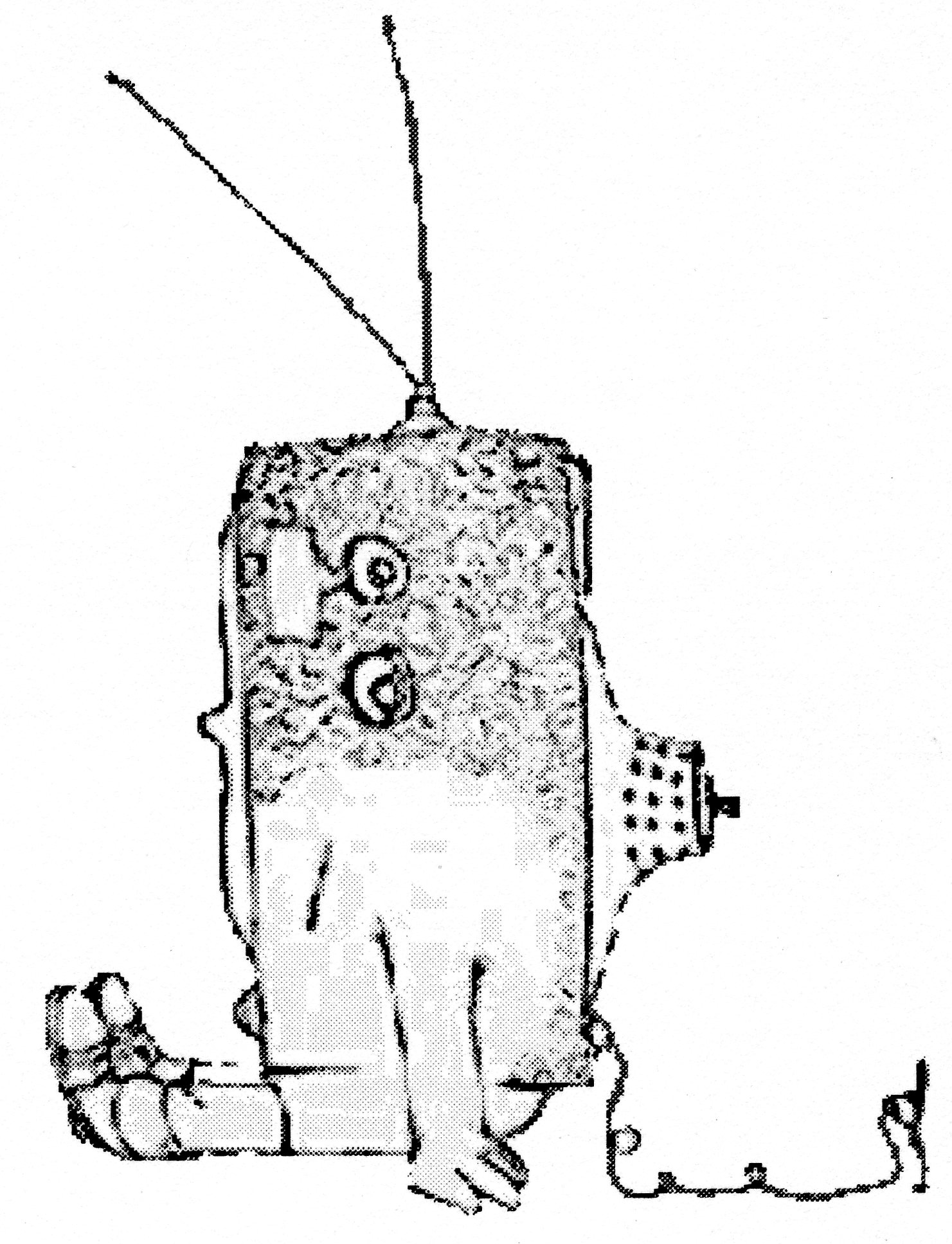
“I’ll tell you the story of Jimmy Jet –
And you know what I tell you is true.
He loved to watch his TV set
Almost as much as you.”*

*Text, from his children’s poem, “Jimmy Jet and His TV Set,”
and embedded sketches are by Shel Silverstein
(Where the Sidewalk Ends, 1974).

Tuesday, 6:47 PM, thirty-five years later…

“Hey.” Jimmy was beat, and was beginning to suspect the internship the summer before he graduated had be a hoax. Just two excruciatingly stressful days into the week, and he’d had it. Monday’s trip out of town on business hadn’t gone well, but he was back. Tired, disheveled, he plopped his computer case and small duffle bag onto hallway floor in front of his apartment, and started fumbling for his keys just as Melissa got off the elevator and turned toward her apartment, the one directly across the hall from his.

“Hey,” she responded, her raincoat folded over her left arm above the briefcase and handbag she was carrying, an overstuffed bag of groceries in the other.

“Here, let me help you with that.” He was crazy about Melissa, and pretty sure she liked him, but getting their deal underway was taking forever.

“Sure,” she smiled back at him, the sparkle in her eyes coming back on-line as she did. “Hold this while I get my key.” He did, and she opened the door to her place. Walking inside past the kitchen, with Jimmy right behind her, Melissa dumped her stuff on the table, large enough for just two chairs, and turned back to Jimmy to take the groceries.

“Spaghetti and turkey meatballs?” she asked him, hoping he’d come over.

Jimmy’s eyes looked away from hers, for just a second, at the French bread sticking out of the bag. “On-the-couch-picnic, in time for ‘Bones’ at 8? It’s an episode I haven’t seen.”

She almost forgot to say anything, but remembered just before it became weird. “Deal.”

Jimmy just stood there, reaching out for the door knob a full five feet behind him. Seeing his dilemma, Melissa put her hand against his chest and started walking, slowly pushing him back a couple of steps until he made contact.

“See you later,” he said, to which she nodded slowly back at him – no smile this time, but more of an expression resolute with anticipation that made him nervous.

Across the hall, he fumbled again for his keys, pushed his door open just crack, holding it open while he picked up the bags he’d left on the floor. Looking down, he saw the telltale whiskers of his cat who thought he was hiding from him, hoping he would open to door too wide and give him the shot he needed. “Hey, Dubie.” (It was short for “Dubious,” which described his gray and white cat perfectly.) Shuffling in, Jimmy did his best to prevent Dubie from escaping. “Miss me?”

“Meeeh,” which, according to Jimmy when Melissa asked him once, was Dubie-speak for, “You bet your bald ass I did!” Dubie was small, but then so was Jimmy’s apartment, the mirror image of Melissa’s.

Throwing both switches on the wall, the hall and kitchen lights went on. The flat screen in the living room was already on, having been set to bring up the NBC Nightly News at 6:30, and then switchover to the CBS Evening News “with Kay-tee Cur-ick” at 7. Jimmy loved saying her name with the announcer and, to disclose something he’d never admitted to anyone, thought she was hot. The TV in the corner of his bedroom did the same.

Pushing his door shut, he slid his computer case on the table by the kitchen, unzipped it and plugged in his laptop using the extra cord he kept at home, opened the lid, and repressed the on button, hardly missing a step on his way toward the balcony to see if Dubie was out of food and water.

The two TVs made it possible for him to move from room to room without having to wait for a commercial. Both sets were always on, even when he slept, a habit he’d picked up when he was a kid. At work, his computer was on-line all the time, his phone keeping him connected whenever he was out.

Changing out of his suit, Jimmy put on jeans and a t-shirt, and then had a thought that required a video call to Melissa.

“Hey.” He was in front of his webcam, she was in front of hers which was on a desk she had in her bedroom.

“Hey.”

“What are you doing?” as if he didn’t know.

“Changing into my jammies,” by which she meant the sweat pants and t-shirt she wore to bed. “But then that’s why you called,” she chided, moving her face right up to the screen, “isn’t it?”

“Actually, I called to ask if I should make some Sangria.”

“Oh, yeh? Well,” she thought for a moment, tying up her shoulder length hair into a haphazard bun, “sure. …No peeking,” she advised him, waving her finger back and forth in front of the camera as if she was scolding him.

“Of course not,” he agreed, covering his face with is hand, but spreading his fingers to let his right eye keep watching.

Turning around, but moving only slightly away from being directly in front of the camera – Melissa unbuttoned and took off the business blouse she’d worn to work that day, and the bra under it. “How was your trip?”

“Okay. ..I’ll tell you about it over dinner.” Talking now would only break his concentration. Melissa had told him that she’d read in one of her Anthropology textbooks that men were programmed to do only one thing at a time.

Her back facing the camera, she looked over her shoulder to see if he was watching, careful not to turn too far around as she did. He was still there alright, and quickly closed up his fingers while she stretched her t-shirt over her hair and pulled it down. “I’ve got to fix dinner. See you later,” and she left the room, knowing full well, and liking every second of it, that he was still standing there, staring at the screen.

She had just the one TV in her living room on which “Access Hollywood” was bringing her up to date on the world of entertainment. If she’d been paying attention, she’d have learned that Michael Jackson was still dead, but hadn’t been buried yet. Why this particular show? Because it was so much better than “Entertainment Tonight.” Just in case, she’d straighten up her room, but not so much to make it look as if no one really lived there. Her blouse and bra were left purposely tossed over the back of her chair. (She’d had to do it twice to get it to look just right.) And the sheet and light blanket she slept under were pulled up, but not all the way, the one pillow left propped up vertically, and pushed in lightly on top of the other as if she’d been sitting up in bed reading.

At 7:45 exactly, she was in the kitchen now, stirring a pot of store-bought tomato sauce and some turkey meatballs she’d made a few days before. A big bowl of salad, napkins, silverware and plates were on the table for them to pick up, buffet-style, when her phone on the counter made its familiar “boob boop” to indicate an incoming text. “Knock, knock,” the screen said.

Going to the door, she looked through her peep hole, knowing who it was of course, but wanting to make it official. And there was Jimmy, checking his office e-mail, his arm under Dubie who insisted on coming, a pitcher of red wine and fruit in his other hand.

8:57 PM. Dinner had been delicious. The entire bread was gone, together with an entire stick of cold, real butter, and they were down to sucking on the orange slices left soaking in the pitcher of Sangria. Dubie was somewhere, but neither of them cared. Melissa had given him a couple pieces of meatball which he ate off the coffee table, and were the highlight of his day. Odds were he was taking a nap.

It was a good episode of “Bones” through which they talked and laughed incessantly about every detail, speculating about the precise circumstances when Dr. Brennan and Agent Booth would finally make it official. It was their way, Jimmy’s and Melissa’s, of asking the same question about themselves.

As fate would have it, Melissa had sliced up the half a watermelon she’d bought over the weekend, just in case. It was Jimmy’s favorite dessert. The two of them sat there, some Lifetime movie starting up on the wide, HDTV a few feet across from them. Kitchen towels spread out on the coffee table, they leaned over, burying their faces into juicy, sweet slices, spitting their seeds, as best they could, into the glass bowl between them, only half of which made it. Three minutes later, they were making out like teenagers, which they barely weren’t, in a frenzied explosion of pent up passion, watermelon juice dribbling recklessly down the sides of their mouths and on their hands, grabbing at each other’s faces and t-shirts. …until the cable went out, and they stopped.

“What was that?” Jimmy asked, almost in whisper.

“Why are you whispering?”

“It’s so quiet.” Their mouths were less than an inch apart.

“So? “

Jimmy’s eyes began darting between Melissa’s and the TV, now nothing more than a black window on the wall. His blinking became erratic, his breathing labored.

“Jimmy?” And just as quickly, the cable came back. The glowing lights and sounds of dialog and soundtrack filling the darkened room.

Turning back toward her, she felt the strength returning to his hands, moving again under her t-shirt – and they got back to finishing what they had started. Right there on the couch, because there was no TV in the bedroom and Melissa wasn’t about to risk it.

-wf
Jimmy Jet 090509

That's Amanda on the right.

That's Melissa on the right.

What to read more? Just click here and pick a title you like.

Copyright as of the title date or earlier, by me.
(I write the WordFeeder blog.)  All rights reserved.
Email WordFeeder@verizon.net for additional information.

Saul’s Laws:* #9. Selfish Behavior

Saturday, September 5, 2009

*See the Preface to the “Saul’s Laws” page at the WordFeeder.

Saul was one of the good guys. Most people… No. Everyone, except me, who knew him assumed it was because he genuinely liked people, which was true. In fact, my father taught me to like and trust everyone I met – regardless of any superficial attributes, gender, race, style, whatever – until they gave me good reason not to. (It’s Saul’s Law #22: Relationships, which includes a corollary that, I discovered when I was in college, is really helpful for men wanting to meet women and visa versa.) Saul liked people alright, but what was interesting was his confessed reason behind everything he did which, he theorized, was the same for all of us.

“Everyone,” he told me, “does everything for selfish reasons.”

Whatever we do, it’s not because we want to improve the condition of the other person, it’s because helping the other person makes us feel better. Now, you say, “Of course.” “Being kind to others is its own reward,” so the adage goes. That’s all my father was trying to tell me. Well, you could say that, but you’d be wrong. If that was what he was talking about – that kindness is its own reward – that’s what he would have said. That would be Saul’s Law #9 on “Kindness,” but it isn’t.

My father’s point wasn’t about goodness as a goal in and of itself. He was talking about pure, raw self-indulgence, devoid of any virtue. Academically, I get it, but was he making a technical observation or was he trying to tell me that “the greater good” was a construct, a somewhat superficial belief, recently layered onto the history of our species, that glossed over the primitive motivation at the root of everything we do?

What difference does it make? The difference may have been that he didn’t trust “good.” Selfishness, greed, these were things he believed in, palpable emotions he considered fundamental to being human and, more broadly, to being a living thing of any kind – essential to our survival, and the reason for our tendency to socialize.

Far from being cruel, it was an innocent realization completely consistent with the intellectual honesty which was the subtext of every conversation we ever had.

Some of Saul’s laws were less straightforward, less obvious for their implications that others. Growing up – and, even as an adult, I’m still very much a work in progress – it’s been something I’ve had to deal with. (If my seventh grade teacher, Mrs. Campbell, is reading this, “How are you? And yes, I know a dangling preposition when I see one. Sometimes, I just prefer the way they sound.)

-wf


Site Meter

Saul’s Laws:* #8. Going it alone

Friday, September 4, 2009

*See the Preface to the “Saul’s Laws” page at the WordFeeder.

Saul’s Law on going it alone was an admonition not to. “Don’t try,” my father advised me, “to do important things by yourself.”

At the time, I thought he was talking about himself and my mother, that I shouldn’t be afraid to ask them if ever there was something I was having trouble figuring out on my own. But then he could have just said that, and didn’t. One thing about my father, he seldom blurted. He was smart, no question about it, although it wasn’t so much that he was mentally quick, as it was that he was always thinking and seldom encountered a situation or topic he wasn’t prepared to discuss. The intelligence he demonstrated so casually was hard earned. I think he meant exactly what he said.

It makes sense. There’s a lot we go through growing up and as adults, personally and professionally, that’s more than we can handle well by ourselves. On the other hand, and here’s the rub, my parents brought me up to be independent, to be able to take care of myself, to figure out things on my own and be proud of it. Independence was equated with strength. Dependence, with weakness.

“Life’s full of contradictions” could have been one of Saul’s Laws, but wasn’t. I guess it was one of those things he expected me to figure out for myself.

There was more to it that came later: “When you reach out for someone to help you, Son,” he called me “Son” and almost never by my given name, “and they do, be sure to help that person back if you ever get the chance, or someone else if you don’t.” The fact was, he taught me by his example over the years I lived at home, sometimes you’ll find yourself helping other people just for the heck of it. He thought of it as making a deposit, of banking the goodwill until he or someone else needed it someday.

No doubt about it, my father was one of the good guys, but not entirely for the usual reasons you might be assuming. You’ll understand when you learn Saul’s 9th Law of Business and Life: “Selfish Behavior,” next up.

-wf


Site Meter

Saul’s Laws:* #7. Timing

Thursday, September 3, 2009

*See the Preface to the “Saul’s Laws” page at the WordFeeder.

I have a little voice, sort of. It doesn’t talk to me. It types, in Courier, in the air in front of my face so I can read what it says, each letter materializing, one at a time to the distinctive sound of the keys hitting the roller on an old manual typewriter. And then it pauses and hits the period very deliberately, as if to say the word “Period” out loud.

When I was a senior in college, I came back from a date with a girl who lived on the women’s campus across town. While I was waiting for her in the lobby of her dorm that morning, I had run into another girl who I had dated for almost two years. I’d been crazy about her, but we had broken up and I hadn’t seen her for some time. We talked briefly when she came out to pick up her copy of the Saturday paper. It was nice, but then she left to go back to her room.

Later that evening in my apartment, I was standing in front of the mirror over my bathroom sink, not thinking about anything in particular, when my little voice typed out the following message, one keystroke at a time: “Y o u ’ r e g o i n g t o m a r r y E l l e n” … “.” And because my little voice has never been wrong, never, I walked over to the phone in my bedroom and called her. I told her, straight away, that I was coming over the following morning to ask her to marry me. She told me she had a date, and I told her to break it. She did. I asked her, and we were married that summer.

Marrying Ellen turns out to be the smartest thing I’ve ever done, so you can understand how much I respect my little voice.

Mostly, I rely upon my little voice to help me resolve less life shaping issues. I’ll be thinking about something all day and late into the evening until I pass out on our bed. The next morning, I get up, fill up the sink with hot water, lather up and, more often than not a short sentence materializes, one Courier letter at a time in front of me. “Pricing won’t be affected,” or “A wet bird never flies at night,” whatever, and that turns out to be the key to figuring out what I couldn’t the day before.

Sometimes my little voice is very, very specific. I’ll have written something the day before. Could be 10, 20 pages which I’ve proofread two, three times. It’s perfect, but it’s too late. No one will be there on the other end to read it so, what the heck, I put off sending it until the morning. I get up, sit on the edge of my bed for a moment and, “At the bottom of page 4, you left out the ‘to’.” Unbelievable, isn’t it. All night, while I was sleeping, my brain was thinking, going over the text of what I wrote, word by word, remembering it in a way I could never do consciously, and then waiting patiently for me to get up before bringing me up to date. More likely, it was something I had noticed, but never thought about fixing. Either way, very impressive.

The other day I was writing a piece (“Congressional Dreaming: Doing Away With The Senate And Other Radical Changes We Need To Make Congress Work”) in which I advocated, among other things, reducing the House to only 100 Members so they can finally get something done. Fortunately, I slept on the idea, with the TV still on in the corner of our room, until I was awaken in the middle of the night by the unbelievably annoying “ehhh, ehhhh” of the emergency broadcast claxon. (If it were a nuclear attack, I’d probably assume it was a test and sleep through it.) Reaching over Ellen for the remote control on her nightstand, I froze for a moment while my little voice typed out suggestion, “1,000,000 people per Representative.” It was a much better idea which I wrote it down on the pad I keep beside my bed so I wouldn’t forget.

Time and time again, I’ve saved my tush from making costly or embarrassing errors just by giving myself the night to let my brain and its little voice do what they do best – proof positive of Saul’s Law #7 which says,

If it doesn’t make any difference whether or not something you’ve written, or need to tell someone, goes out at the end of the day, or the beginning of the next, always wait until the morning. Something may occur to you in the meantime.

By the way, I’m just finishing this up at 11:04 PM with plenty of energy left to watch at least the first half hour of Conan while I do the dishes… (You know who is already asleep on the couch.) …but no way am I posting it tonight.

“G o o d,” wait for it, “.” Hey? Who typed that?

-wf


Site Meter

Saul’s Laws:* #6. Doubt

Tuesday, September 1, 2009

*See the Preface to the “Saul’s Laws” page at the WordFeeder.

Ever said, written or done something, something important that you weren’t entirely sure about, and then regretted it?

The uncertainty you were feeling was your brain’s way of telling you that it didn’t had enough time or information to evaluate the consequences of what you were about to do. Or maybe it was that emotions were attempting a coup, taking charge of your decision process, rather than just being content to be part of it. Who knows?

The only thing we can say for sure is that, for some reason, you weren’t comfortable. There was a palpable, at least momentary uneasiness that you had to ignore or override. Could be fear you were experiencing. More often, it was the apprehension, the mixed signals that come from inexperience or from the conflict between what you’ve learned from experience or have been taught and the circumstances of the moment.

It’s for times like these that we have this particular Saul’s Law: “If you have any real doubt about doing something, something that could be important, don’t do it. Wait until it feels right.” Still want to do or say it? Maybe you can change the rules or context, even a single word can make a difference, until the instinctive uneasiness you’re feeling has resolved itself.

Too conservative for you? What? You we’re expecting something more like, “When in doubt, go for it.”? My father was a Republican.

The more astute among you may be sensing a contradiction between this law and #5: “Never let being afraid stop you from doing the right thing.” For the record, in the latter case, Saul was talking about doing things having moral or ethical content, not bungee jumping.

Also for the record, Saul’s Laws are full of contradictions. When I was older, and would confront him on just this point, he would argue that it was on purpose, but I would see the corners of his mouth turning up which was a sure sign he was just pretending to have thought about it. In fact, if there was one thing he was trying to accomplish, it was to get me to think, about what he had to say and everything else. At that, he pretty much succeeded.

-wf


Site Meter

Saul’s Laws:* #5. Integrity

Sunday, August 30, 2009
*See the Preface to the “Saul’s Laws” page at the WordFeeder.

“Never let being afraid stop you from doing the right thing.”

This was another one of Saul’s original laws. His words exactly. Told to a little kid, they left an indelible impression.

I’ve always wondered what was going on in his life at the time that prompted this unsolicited advice offered to his six year old son, working with his father in their basement shop one Saturday morning.

-wf


Site Meter

Corporate Culture

Short Fiction for Guests of the WordFeeder
Sunday, August 30, 2009

It was a case of “unauthorized schtupping” which was what it said, in more professional terms, on the papers when Jeremy’s wife of just three years sued him for divorce. As for the more common description, those were the words of the division’s President, Howie Rackman, who thought he was funny, but wasn’t. Only three years from retirement, Rackman’s sensitivities and terminology were those of a very different time.

“Schtupping,” from the Yiddish “schtupn” meaning to push (in) or press. Rackman, who wasn’t Jewish, but who had secretly always wanted to be, thought it was funny to mock Jeremy’s ethnicity, laughing out loud when he did, shaking his head from side to side as he marveled at the wit only he appreciated. (He also wanted to be Italian, but only if he could have the accent he was certain women found irresistible.) At least he was an equal opportunity jerk, having no qualms about offending anyone regardless of their origins or type – and women, women in particular whom he considered inferior, little more than interesting toys for the men in their lives and his company. “Somebody has to do all this clerical shit,” he often remarked around the conference table after one of the young female assistants who worked with senior management would leave to get coffee, make copies or do “God know what.” It was no accident that they were all young and attractive. That was, after all, the primary reason they were hired.

Jeremy Levitz, the senior Assistant Manager in the division, just three years out of Wharton with his MBA, never fit in and couldn’t get the promotions his work deserved. The market was soft, so he couldn’t leave. What he wanted was to manage one of the new offices they were opening – get the hell out of corporate, spend the next three years building that office his way and then move back to headquarters after Rackman retired.

Jeremy was good enough for management to take credit for his work, but not good enough to be one of them. Their nominal excuse was his lack of experience. The real reason was that they didn’t want the competition and couldn’t overwork and otherwise exploit one of their own, and that meant denying Jeremy membership in their exclusive club of over-paid, under-performing senior division executives.

And then there was Ruth. 30. Unquestionably the hottest “shiksa” in the office. (Rackman liked to use these terms like they were his own. “Ever wonder to yourself,” Jeremy once asked his wife, “where politically incorrect expressions go to die? Now you know.”) As close to being “one of the boys” as a woman could be, she’d earned every dollar she’d made putting up with their crap, never letting them get to her, keeping her distance – never once having had so much as dinner with one of them. Rackman and his posse didn’t respect her, not really, so much as they feared having to deal with her. She made them nervous for the wrong and inappropriate reasons.

She and Jeremy were the ones who made the division happen. Everyone in their division knew it. More to the point, so did corporate management two floors up. They tolerated Rackman as a legacy, for his work with the founder building the company decades ago, but would clean house as soon he left. In the meantime, although neither Ruth nor Jeremy knew it, the two of them were bullet proof. Picking on them, dumping on them was as far as corporate would allow Rackman to go, although being fired might have been a godsend. For the two of them, the next three years under his supervision would seem like ten.

“I need the re-analysis of our southeastern region on my desk Monday morning.” Rackman’s tone was matter-of-fact, barely breaking his stride on his way past Jeremy’s office. Leaving early for the weekend, he wouldn’t be missed. “I’ll need 10 binders, and write me a presentation, big type, you know how I like it, including notes indicating when I point to what. That always impresses them. …Use Ruth for whatever you need,” he added, raising his eyebrows as if those instructions had sexual implications. (Ruth had wondered out loud to Jeremy once, after a particularly slimy exchange with Rackman, whether or not he had a clue how truly unattractive he was? It was a rhetorical observation.) “See you,” and he was off without bothering to ask if there might be any questions, utter a “Thanks” or wait for Jeremy to nod his acceptance. Just a “Whoa. Hold the elevator,” in which everyone was begging the doors to shut more quickly, and he was gone.

“Asshole,” Jeremy mumbled under his breath, rolling his chair to look out at the cityscape and ponder his frustration. He’d been hoping to spend some quality time with Evelyn this weekend, but clearly that wasn’t going to happen. He’d be lucky to get out of his office. Maybe, he thought to himself, eyeing a young women moving wistfully through her office in the building across the street, maybe Evelyn would bring over some carryout that evening and they could get to know the leather on his couch together. Just then, the woman across the street stopped, and turned to face him. Smiling, she waved and let him lip read the word, “Hey.” He smiled and waived back at her the way they often did, both of them slightly embarrassed by their long-distance relationship as she walked away and out of her office. Seeing her like that, the girl with short blond hair he’d never met, was often the highlight of his day.

Turning back to his desk, Jeremy reached for his phone, thinking he’d better call Evelyn, just before it “buzzzz”d at him. Pressing the intercom button, he said the usual, “This is Jeremy. What do you need?”

“Hey. It’s Irene,” the receptionist on that floor. “There’s a messenger here with some papers he says he has to give to you, personally. Can you come out, or should I walk him back.”

“Thanks. Here I come.”

It was to the right, just down the open hallway formed by the offices along the perimeter and waist-height carrels in the middle of the floor. Turning the corner past the upholstered furniture in the small lobby, instead of the usual bicycle messenger smelling like he had just been on fire, there was a young man, in his early twenties wearing a suit. Hearing someone coming, he was quick to break off his vain attempt to score points with Irene. It wasn’t that she was so pretty, as it was the effect of her strawberry blonde hair that seemed to have a life of its own.

“Mr. Stein? Jeremy Stein?”

“Yes?”

“This is for you,” he said, taking a 9 x 12 white envelope out of the zippered portfolio he’d been holding against his chest. “And, if you would,” he paused for a moment, looking down to fill in the time on his clipboard form, “Please sign here, in the blank next to your name.” Jeremy scribbled his usual “JStein,” no period after the “J,” looking apprehensively at the return address for one of their city’s boutique law firms, well known for representing women in divorce, workplace and other litigation. “Thank you, Mr. Stein.”

“Yeh,” Jeremy mumbled, putting off opening the envelope until he was back in his office, knowing that Irene would be staring after him wanting to ask what was going on, but being nice enough to understand that it was none of her business.

It was a Friday afternoon, after a long week during which Jeremy had been noticeably upset by some rough calls with his wife, Evelyn, his end of the arguments having been overheard through his office walls even though he’d been trying to keep it down. Apparently she’d had it with the endless late night sessions at the office working with Ruth, often going until 1 or 2 AM, not to mention the weekends.

He was surprised, having been more or less oblivious to his marriage during the past year, but then he wasn’t. They were divorce papers alright, accusing him of adultery, naming Ruth Smythe the subject of his indiscretions. Ruth would deny the accusations vehemently, but no one would believe her – not even her friends among the other women in the office who had seen the two of them working together, heard the occasional laughter, seen them touch or brush up against each other when no one was supposed to be looking. It might have appeared innocent enough at the time, but now it made perfectly good sense.

By Monday afternoon, everyone knew. At first, and to everyone’s surprise, management wasn’t annoyed at their intra-office affair. Far from it, they were impressed that Jeremy had nailed, repeatedly, the hottest girl in the office – and at the office, no less. For Rackman and his yes-men, it was enough to make them tear-up. “Way to go, Jeremy. Good work.” They didn’t say it out loud, but you could read it on their faces and in the way they had started treating Jeremy. Make him one the boys, his sexual conquests rub off on them. The fact was, they still didn’t like him. All this new found comradery was more about minimizing Ruth. Respecting Jeremy had nothing to do with it.

And so they were feeling pretty good about themselves, living vicariously through Jeremy, until Ruth showed up with her attorney – a striking, if severe looking woman – who sat down in Rackman’s office, door shut, and explained, in no uncertain terms, how her client was going to sue his company’s ass off for sexual harassment and discrimination. Proof? What proof did she have? Sexual harassment and discrimination are always so hard to prove.

Ruth’s attorney wasn’t about to concede any ground. “Mr. Rackman, you don’t honestly think a jury is going believe anything you have to say? You don’t have a single woman in any management position, not here or in any of your offices. With a couple of exceptions in the mail room, the entire clerical staff is female, young and attractive. No one over 40, no one overweight – and every one of them underpaid according to agency and government industry surveys.”

“This is extortion. This sex stuff was between Levitz and your client. Strictly personal business. What’s the company got to do with it?”

“You’re not really paying attention, are you Mr. Rackman? In the past 4 years, different men on your management team – including you – have asked my client out to dinner – a dinner “date” mind you, with no business purpose – on seven documented occasions, all of which invitations she declined. During the same period, she’s received nothing more than routine, minimal increases in salary, despite very substantial expansion of her responsibilities and three “Superior Performance Memoranda” for work which came to the attention of senior corporate management…”

You’d think Rackman wouldn’t have talked to them without his own counsel in the room, but that would have included corporate in the conversation. Turns out a significant portion of his retirement income is subject to Board approval. The kind of mess Ruth’s attorney was threatening wouldn’t be good for him.

“…And now, when she’s required to work under an Assistant Manager with less experience than she has, but who she has to please and, by inference, please you to keep her job, this happens!” The attorney held up her copy of the divorce papers. “’Use Ruth for whatever you want’? Are you kidding? That’s the way you talk about a female professional, raised eyebrows and a condescending smirk on your face, in earshot of the staff she supervises? Do you really want to take us on?”

“What do want?”

“Surprisingly little. You’ve got two new regional offices opening up in Savannah and Phoenix for which you’re advertising for managers. Levitz gets Savannah. My client wants Phoenix. Three year, no cut contracts, with standard executive level benefits, increases and bonuses. Promotions effective the first of next month.”

Rackman was quiet, doing his best to avoid the stare of the women sitting on the other side of his desk. And then he looked up, leaning back in his chair. “What the fuck. Your client can have Phoenix. Too damn hot, if you ask me, but why do you care what happens to Levitz?”

“My client feels that he’s basically an okay guy, who shouldn’t lose his job over something that’s really your fault. His marriage is over. It’ll be enough to have him reassigned to a startup office. You’ll just have to learn to live without the two of them.”

No reaction. (Unbelievably, Rackman was too busy staring at the attorney’s legs, her skirt a full three inches above her knee.)

“Besides, what do you care? Just agree and all this goes away.”

“You’re right,” he said, getting back to the issue at hand, “I don’t care. Consider it done.”

“We’ll expect both contracts in my inbox by COB Friday. My e-mail address is on my card. “

His pursed lips and inability to look them in the face were the only response they were going to get. Picking up the card the lawyer had given him when they first came into his office, he tapped the edge of it on his desk and waited for the sound of them pushing back their chairs to get up and leave.

Two weeks later…

“Hey, Ruth!” Jeremy realized it was her before he answered, calling from her new Phoenix area code cell phone number. “Are you having as much fun as I am?”

“More! How’s Evelyn? Are you settled in yet?”

“Yeah, we’re fine. What’s not to like. The city’s great. We virtually live on the ocean, and her parents and sister are less than an hour away.”

“Not to mention the money!!” He could have almost heard her laughing without the cell phones. “Absolutely the best idea Evelyn ever had!”

“Hi, honey. It’s Ruth.” Evelyn, holding the carryout they ordered, had just poked her head, to be funny, around the corner of the open door to his office. Jeremy would be working late tonight and they thought they’d unwrap his new chairs and leather couch together.”

“Here,” she reached for his phone, “give it to me.” “Hey, Ruthie! Thanks for your help with all this.”

“Are you kidding? I just wish I’d thought of it – or had a cousin who’s a women’s rights attorney.”

“Consider it a team effort. Rackman’s been screwing you and Jeremy all this time. The least we could do is return the favor.”

-wf

What to read more? Just click here and pick a title you like.

Copyright as of the title date or earlier, by me.
(I write the WordFeeder blog.)  All rights reserved.
Email WordFeeder@verizon.net for additional information.

Saul’s Laws:* #4. Binary Decision Making

Saturday, August 29, 2009
*See the Preface to the “Saul’s Laws” page at the WordFeeder.

Some of Saul’s Laws are technical, like this one.

We are a people with way too many choices. Making the routine decisions of our lives has become too time-consuming and the source of petty, but sometimes major stress we really don’t need. Whether you’re trying to pick out a color to repaint your bedroom, choose the perfect new cell phone or figure out which one of the girls in your dorm you should ask out first, we’ve all had the problem of picking “the one” out of many.

Whenever possible, reduce all decisions to choices between just two alternatives. This is Saul’s Law of Binary Decision Making. It’s a simple trick. Try it. It works. What the law forces you to do is organize your thinking. Rather than seeing all the options in front of you as a single blob that’s starting to make your head hurt, Binary Decision Making steps you through the process of quickly reducing your options to the point of choosing between or among the last two or three.

Whenever you need to choose from among a number of things, start by discarding the one you like least, or that you know you like less than at least one of the others, and then work your way up to the two or three you like most, eliminating the least attractive alternatives as you go

If you’re facing three alternatives, and are having trouble deciding among them, pair them off. Look for a pair with one alternative you prefer over the other and eliminate that one, the one you like less. Then work on the two that are left.

The first couple of times you do this, it may seem time consuming. Be patient. It’s an illusion that will go away with experience. Not only will complicated, multiple choice decisions be less stressful, the results will more accurately represent your preferences because you’re not rushing your decision or avoiding having to think it through by just picking something to get it over with.

Go ahead. Two at a time. You’ll thank me in the morning.

-wf


Site Meter

Saul’s First Three Laws of Business and Life*

Friday, August 28, 2009
*See the Preface to the “Saul’s Laws” page at the WordFeeder.

Humor. Integrity. Character. These were things my father (and mother) taught me by example. The subject of these posts are laws about which he was very specific. Some of them, like these first, seemed to be about business, but I suspected then even as a little kid, and am sure now, were meant to be about life in general.

Newton had his three laws of motion. Well, these were Saul’s first three laws of business:

1. Compromise. Everything is negotiable, although some things are more negotiable than others.

2. Focus. Never sell more than one thing at a time.

3. Truth. Never sell anything you don’t believe in, and it wasn’t just business he was talking about. (He also taught me how to draw a straight line along the edge of a board without using a ruler or square.)

My father, by the way, wasn’t a career salesman. He was, nonetheless, the most effective salesman I’ve ever met – second only to me. But then I don’t count, given that everything I know about sales, I learned from him. No, I’m not a professional salesman either. It’s just that we’re all selling, all the time, and I suspect that’s why these were the first laws he taught me.

-wf


Site Meter

Guardian

Short Fiction for Guests of the WordFeeder
Sunday, August 16, 2009

Between every parent and child there is a certain magic
which the fear of an innocent can call upon
to prevail in the darkest of situations.

Lieutenant Roberts, in his late 30s, a senior Detective with the same police department where he started work after college, was all too used to getting calls in the middle of the night. It had been one of his earliest realizations that he would grow up and live his life in the state of his parents and grandparents. This place was his home and these people, all of them, were family, whatever time of day or night they needed his help.

Having been asleep when they called him, by the time he arrived before dawn that early summer morning he had to pull up a few houses down from the crime scene and walk towards the police cars and ambulances that were in front of the Colby’s two story colonial. It was a nice neighborhood, one of the newer subdivisions in this county that couldn’t resist the lure of growth.

Rushing up to where two ME Assistants were rolling a body bag down the driveway, he saw Detective Sclorowsky look up from the notes she was making to greet him. Recognizing the look of concern on Roberts’ face, she didn’t waste any time bringing him up to date.

“That’s one of the two that broke in,” she started, gesturing over her shoulder toward the open rear doors of the ambulance nearest to where they were standing. “The other one, also dead, will be out in a minute.”

“And the…”

“No one in the family was badly hurt. Just the mother and her 5 year old daughter were at home. The father’s out of state on business, but on his way back now. He should be here in a few hours.”

“Just the mother and a 5 year old took out both of them?”

“Not exactly. …Let’s go inside. You’ll need to hear this for yourself.”

The house, still busy with police officers and forensic specialists, was good sized, but not huge, comfortably furnished with the clutter and stuff of life here and there where you’d expect it to be. Waiting for them inside, the mother sat nervously on a love seat in their family room, her daughter next to her, her feet stopping a few inches short of the rug that covered the center of their hardwood floor.

Detective Sclorowsky pulled up the leather chair from the other side of the room, but Roberts wanted to be closer and sat on the refinished wooden trunk they used as their coffee table. Both women seemed remarkably calm, the events of the night not having fully affected them yet. That would happen soon enough which is why he had to talk to them now before they became any more distracted by the reality of what had happened. With some people, you have to wait a day or two. Others were best when you talked to them right away. Over the years, he’d learned to tell the difference.

“Hi, Mrs. Colby. My name is Jacob Roberts. ..and you,” he smiled ever so slightly, turning a bit to his right, “must be Emma.”

The little girl nodded her head up and down, but said nothing.

“Mrs. Colby, I know you’ve been through all this before with Detective Sclorowsky but, if you could, tell me the basics of what happened.”

An attractive, slender brunette with wavy shoulder length hair, she looked remarkable given what she’d just been through. Outward appearances aside, it seemed for a moment that she wouldn’t be able to speak. A large bruise was coming to the surface of the left side of her face where an EMT had clamped and bandaged a cut. “Mrs. Colby?”

“Emma and I have trouble getting to bed sometimes when Michael’s out of town, so we stayed up late, watched a movie together and fell asleep on the couch,” looking up and over at the overstuffed three cushion sofa against the wall behind him. “I don’t know when exactly, but I heard noises coming from the basement. It’s a walkout and I was worried someone might be someone trying to break in. Sometimes I hear sounds from the woods, deer that come up to eat the bushes around the deck, a fox sometimes, but this was different.”

Her voice was steady and deliberate as if she had to concentrate to get the words out. “Did Emma wake up, too?” he asked, thinking it best to interrupt her now and then for her to hear the sound of his voice.

“No. ..No. I…”

“Mommy woke me up.”

Impressed that the little girl was taking the initiative while her mother was clearly stuggling, he turned to encourage her. “What did she say, Emma?”

“She told me the truth. That’s what we’re supposed to do in an e-merg-en-cy.” It was a longer word she had trouble pronouncing.”

“What exactly did she tell you?”

“Mommy said it was the middle of the night, and that there was noise in the basement she was worried about.” Her confidence building, the little girl was relaxed now and anxious to help. “She told me to sneak upstairs, very very quietly, and hide in my bedroom closet while she called 911.”

“Is that what you did?”

“Of course,” Emma responded, almost as if she was wondering if he’d been paying attention.

“And, Mrs. Colby,” Sclorowsky wanted her to include a detail Roberts wouldn’t have known to ask about, “you didn’t call 911, at least not right away, did you?”

“No. I keep my phone on a…,” she paused to catch her breath, “on a charging stand on the counter there,” she explained, pointing toward the kitchen at the other end of the room, past the table where they ate most of their meals. “I came around there, past the refrigerator, but never made it.”

“ …The first one of them came up the basement stairs,” through the doorway just outside the kitchen, “and grabbed me from behind, bringing his arm diagonally across my chest, like this.” She used her right arm to demonstrate. “I could hardly breathe. ..The second man was right behind him, but went off somewhere, while the first one pulled me down the stairs, back into the basement. I tried holding on the molding around the door and then the banister, but I couldn’t get on my feet – and then I thought, maybe when I got downstairs, maybe I’d be able to fight him off. It’s my house. There’re tools in the shop if I could just…” She was starting to have trouble.

“Keep going, Mrs. Colby. You’re doing great.”

“And then he threw me over… It’s open, the stairs are open at the bottom. He threw me over onto the floor. I must have hit my head on something. I’m not sure. It was dark.”

“And you called 911 when you regained consciousness?”

“Yes. When I woke up, it couldn’t have been too long that I was out, I remember hearing screaming and crashing sounds on my way up the basement stairs. That’s when I picked up my cell phone and called the police.”

“Emma?”

“Yes, Detective?” Her formality would have been cute under different circumstances.

“What was happening upstairs, Emma, while your mother was in the basement? What happened in your room?”

She paused for a moment, as if wondering if she should tell him.

“Go ahead honey,” her mother prompted her, reaching out to touch Emma’s hand that was pressing on the cushion between them. “Tell Detective Roberts what you told me.”

Looking up at the Detective, she answered his question with certainty. “Guardian protected me. The two men came into my room, and Guardian protected me just like Daddy said he would.”

“Just Guardian and the two men?”

“Uh huh. ..It hardly seems fair, does it? To the men, I mean.”

Leaning back to distance himself from the little girl, Detective Roberts needed to see her room. “Let’s take a break for a couple minutes. I just want to run upstairs and take a look at your room. Will you wait here for me?”

Once again, Emma nodded her agreement.

“Detective,” he said turning toward Sclorowsky, and the two of them stood up and left the room, on their way down the short hallway toward the stairs and to Emma’s room. “What’s Guardian,” he asked her with quiet impatience when they were out of the room, “the family dog?”

“No. It’s, uh, not a dog.”

“So what’s she talking about?”

“Com’on,” Sclorowsky started up the stairs first, “It’s the kind of thing you need to see to believe. The ME’s pulled the bodies, but you’ll get the point.”

Pushing open the door with her left arm, she moved to the corner of the bed, turning back to Roberts whose eyes began moving slowly from point to point in the mayhem he saw. The room was trashed. There was blood all over the place.

“The preliminary conclusion of the lead tech was that both men were ‘torn to shreds,’ his words, by… by something with very sharp teeth and claws, something powerful, strong enough to bounce a adult male off a wall,” she pointed to a large section of crushed sheetrock next to the dresser, “ and to snap major bones. All the wounds were rough. No precision cuts or holes that he could see. As far as he could tell, there were no manmade weapons involved. Ralph said, if we’d found the bodies in the woods, he be sure it was a wild animal attack.”

Roberts walked into the room, but not far, being careful where he stepped. The walk-in closet was to his right. “Are you absolutely sure there’s no way the kid and her mother did this?”

“No way. The mother was clearly beaten. There’s some blood on the wall across from the bottom of the basement stairs. I think she’s telling the truth. Besides, she’s what, 5’ 4”, maybe 120 pounds?”

“And the father? What about the father?”

“Asleep in a different time zone when all this happened.” Seeing her colleague wasn’t buying it, Sclorowsky turned back a few pages in the spiral notepad she was carrying to go over what Emma had told her when the two of them had talked earlier. “The kid is hiding in her closet, under a high bottom shelf, behind some plastic storage boxes. It’s not a great hiding place, but she feels good about it and can see the door. The closet light was off and the door, shut. Smart girl, she purposely left her bedroom door open so it wouldn’t seem so much like someone might be hiding there. ..There’s no lock on it anyway.”

That got Roberts’ attention, turning his head toward Sclorowsky, away from the gore of the room and its stark contradiction to the walk-in-the-park kids’ wall paper and phosphorescent plastic stars hanging from the ceiling. “She was thinking?” it seemed hard to believe. “With all hell breaking lose around her,” there was no missing the skepticism in the tone of his voice, “she was thinking that clearly? She wasn’t scared out of her mind? Paralyzed with fear?”

Sclorowsky ignored him and continued going through her notes… “So the two men come into the room, one checking under the bed, rummaging through the dresser, who knows, while the other one opens the closet door, looks down and stares right at her. The kid, knowing he sees her, shouts “Daaaaddddyyy!!!” at the top of her lungs, loud enough for her mother to hear her all the way down in the basement. It could have been what woke her up. It’s so loud, both men stop whatever they’re doing. Nothing happens. Zip. Emma says it was quiet for a couple of seconds and then the one looking in the closet door smiles at her, ‘eyes bulging,’ she told me. Looks left, looks right and says to her ‘in a really creepy voice,’ ‘So you were expecting what to happen?’ laughs and then starts to open the door the rest of the way to come and get her. …At which time she says it again, but this time not so loud and with a lot less confidence, ‘Daddy?’”

“All of a sudden, something dark ‘whooshes,’ according to Emma, around from behind the door, from inside the room, ripping into the intruder’s neck – which pretty much wiped the smile off his face. The man reaches up with both hands toward the arm that’s got him just as he’s yanked back, right off his feet, the closet door slamming behind him. There’s tremendous ruckus, noise of furniture crashing and adult men screaming – that even a neighbor heard. It’s suddenly quiet, so the kid gets up, pokes her face out the closet door, steps over the bodies and runs downstairs only to meet her mother on the way up. From what I can tell, the whole struggle couldn’t have taken more than a couple of minutes while the mother was calling 911.”

“And the Medical Examiner?”

“I’m telling you, the mother and the girl couldn’t have done this.”

“So what, they have a pet bear?” Robert’s asked facetiously, searching for a reasonable explanation. “A large housecat,” he tried joking, but the room wouldn’t allow it.

“No. They don’t have any pets. The daughter insists that Guardian did it. He was a gift from her father before he went out of town, to protect her. They just moved here this summer in time to get settled and ready for the school year. The kid didn’t want to move…”

“They never do.”

“…and has been withdrawn, so the father bought her the bear to make her feel safe.”

“I thought you said they didn’t have any pets? Besides, what kind of father buys his kid a wild animal?”

“No pets. Guardian,” she explained, moving away from the end of the bed from where she had blocking Robert’s view of the headboard, is the kid’s stuffed California brown bear.”

And there he sat, as true-to-life as stuffed bears get, about the size of a new bear cub, his faux fur perfect for hugging. Sitting up between two pillows, his plastic eyes appeared to be staring right at them, the expression on his face so innocent and friendly – except, of course, for the blood soaked torn piece of one of the intruder’s t-shirt hanging out the corner of his mouth.

“This is, what, some kind of elaborate prank?” Roberts was hoping it was.

Sclorowsky looked back at him, pursing her lips, shaking her head slowly left to right. “And we’ve got two bodies to prove it. …So tell me,” she asked, walking behind him going down the stairs, “just how do you want me to write this up?”

“Home Invasion Stifled,” so the local paper ran the story, “Intruders Killed By Unidentified Party.” There was even speculation that the killer was a third intruder upset that the other two we’re planning to harm the family. They could speculate all they wanted, Emma would always know what really happened. And the bear would follow her to college and to her apartment after graduation years later – fair warning to petty thieves and worse who might be so foolish as to pay her a visit.

-wf

What to read more? Just click here and pick a title you like.

Copyright as of the title date or earlier, by me.
(I write the WordFeeder blog.)  All rights reserved.
Email WordFeeder@verizon.net for additional information.